SLEEPERS ‘WAKE CHAPTER ELEVEN
ALLELUIA LAUDAMUS TE
April 2026
1) Click here to read chapter one 2) Click here to read chapter two
3) Click here to read chapter three 4) Click here to read chapter four
5) Click here to read chapter five 6) Click here to read chapter six
7) Click here to read chapter 7 8) Click here to read chapter eight
9) Click here to read chapter nine 10) Click here to read chapter ten
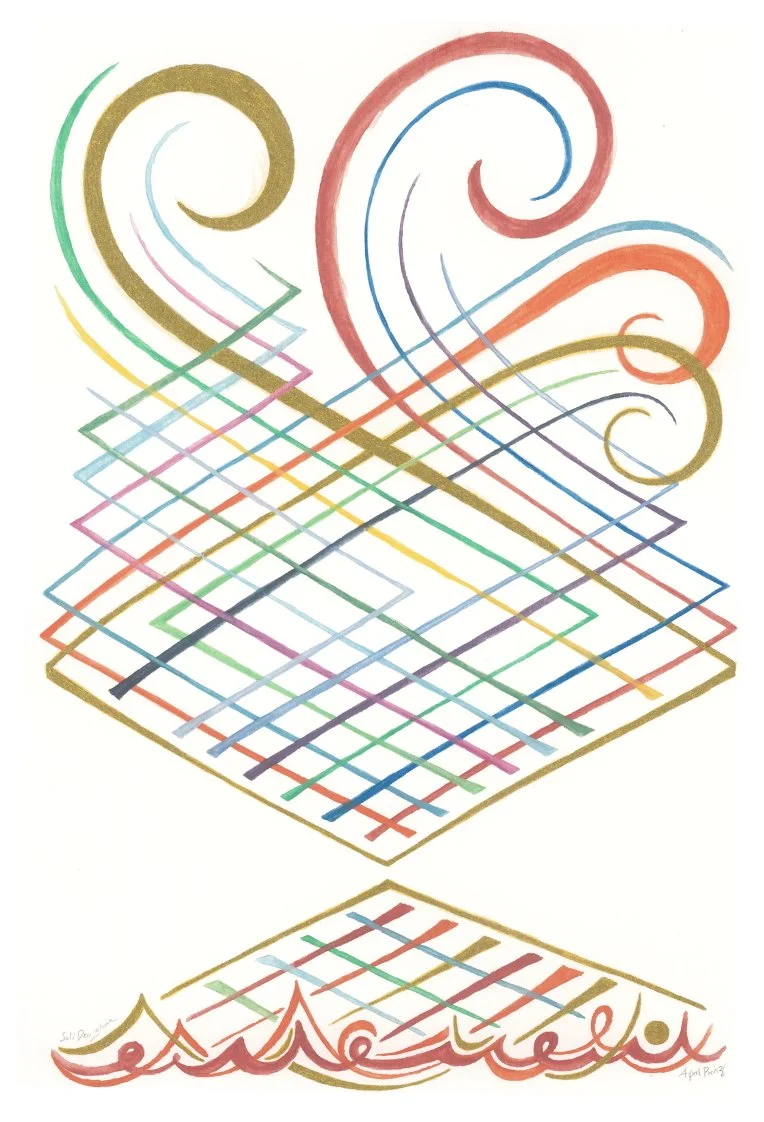
Sleepers ‘wake CXXIV - Alleluia Laudamus Te
March ‘26, Watercolor pencil and gold calligraphy ink, 8” x 10”
I am filled with gratitude and excitement to have been commissioned to create a gift for Doctor Richard Fischer on the occasion of his retirement from Concordia University Chicago. I say filled, but I guess I should clarify. I’m almost filled. There is a part of me that will always be sad that “Doc” has retired from conducting the wind symphony, as I was a member of it for all four years during my time at Concordia. I say always, but once again I realize that some clarification is needed. For now, in this broken world, it feels to me that I will always be sad about it. But if I remember that Jesus is currently fixing this broken creation and will return in glory to fulfill His promise to renew it entirely, I suppose then I should say that I will be sad as long as I am in this broken world. My sadness will one day be turned into something else. Some level of joy that I can’t fathom at this time. My closest imagination of it involves Doc conducting me, and perhaps all of his wind symphony alumni, together, many many times for the rest of our lives. Which will stretch into eternity.
April 1st, 2026
In June of 2024, I attended the alumni reunion at Concordia Chicago celebrating Doc’s 50th anniversary. About half a year later, I wrote about it in Sleepers ‘wake chapter eight. Here are some excerpts from that chapter:
“My husband and I met in that wind symphony and are deeply thankful for the 50 years that ‘Doc’ has served at Concordia University.
It was an incredible weekend. The two things I will always remember most are playing a piece called Alleluia Laudamus Te and Doc’s passion with regards to his faith. The combination of those two things made me feel like I was playing my flute amongst the host of heaven, every time we played it. We played that piece every year while I was at Concordia, and I loved it the whole time. Playing it again was so nostalgic and joyful. It is one of Doc’s favorite pieces. He passionately described the various sections of the piece and how they repeat and thread together. It felt like a Sleepers ‘wake. In fact, one day I’m hoping to create an Alleluia Laudamus Te Sleepers ‘wake. We’ll see when/if the time arises : )”
Well the time has come! Praise God! And I’m so thankful to Nikkole Huss for reaching out to me about it. She is filled with so much care and thoughtfulness. What a gift she is.
Okay, so what is the meaning of this piece?
Well... I work for a community arts center in St. Louis called Intersect Arts Center. It is closely affiliated with my church, Holy Cross Lutheran Church, for which I also work. We spend a great deal of time listening to visual artists and interpreting their work. I’ve been greatly influenced by the people in my space to think vastly about the meaning behind an artist’s work and also to place it next to God’s work and see what connections there are to be made. It is a very exciting life. There are always so many connections. And this is another beautiful way that God continues to draw me closer to Him.
So I’ve done that with Alfred Reed’s Alleluia Laudamus Te. His musical piece is a hymn of praise without words. So my visual piece is a hymn of praise without words... or music.... Ha! Although, I actually think there is music. It’s just visual music. But I think that’s probably a topic for another day.
So let me explain how my abstract piece of art illustrates Alleluia Laudamus Te. I am fully aware that abstract art can be strange and feel hard to grasp. To some people it may even seem irrelevant or useless. Perhaps just visual noise. But please, if you are one of those people, humor me for a bit and see if your mind can open up to a new beautiful practice of valuing something you didn’t before. Remember how exciting that feeling is?
Okay this is really it now. I will actually explain it now.
I would recommend listening to Alleluia Laudamus Te before reading on. While you do, listen closely to the three different themes that are the foundation of the piece. Here is a video of Doc conducting it!
Did you hear the three themes? The piece begins with the A theme, a triumphant explosion involving the entire ensemble, as far as I can tell (except for the organ, who comes in later. But don’t think about that yet. It’s a surprise for later). Then pretty quickly, it transitions gently into the B theme. The B theme is a lilting section that slowly brings in one woodwind voice, and then another voice threading in and out of it with a similar melody. Then it happens again with the brass, but the clarinets come back, weaving in and out, like a conversation. Everyone joins in together at the end of this theme to gently and casually transition us into the C theme.
The C theme feels like we’ve entered into a new world now. It begins like a soft serious and slightly dissonant fanfare, as if we are being sent on a journey, which the sender knows is going to be difficult. The fanfare continues into a less dissonant and louder, more determined, feel, as if we are now on our journey and duty-driven to succeed. It continues within this sort of a feeling for quite some time. It’s as if the music is illustrating an adventure filled with all kinds of twists and turns. Then it hits a section where it seems the journey has come to a very exciting moment. Is it the end of the journey? Or is it the moment we’ve succeeded in finding something that will help us to fulfill our quest? Or is it what we thought was the end of the journey, but actually it is now the start of a new and better journey?
It’s that. It turns out the C theme ends by joyfully introducing the return of the B theme. And the journey continues. But the journey is now only joyful. And the organ has arrived! Are you surprised? You should be. When the organ comes in, it is very exciting. If you’re not sure about that, ask Doc. He knows.
So the B theme is back now. This time with the whole ensemble playing that lilting melody. Their voices thread in and out of each-other like a giant choir. They sing for a little while, but then instead of gently transitioning into the C theme, as before, the B theme excitedly and thoroughly proclaims the return of the A theme! The A theme is bigger now. Of course we have the organ. But there is also more to the melody. It leaps higher than before. It can fly now. And when the piece ends with the A theme, it doesn’t feel like an actual end, because it’s the beginning again.
Okay hold on tight. The tenses are going to be all over the place in a minute. But if you pay attention, you will see how applicable that is to the Now and Not Yet where we currently live.
My Alleluia Laudamus Te begins with a visual interpretation of the A theme at the bottom:

When I hear the A theme, I hear God saying “Let there be light!” And on the word “light” the piece begins. My A theme imagines God creating the universe. The red symbolizes God the Father. The orange symbolizes the Holy Spirit. And the gold symbolizes God the Son.
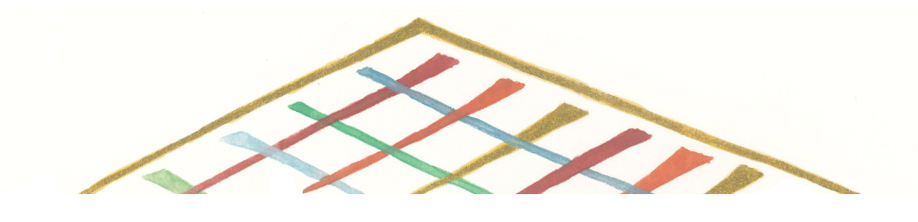
When the B theme comes in the first time, I illustrate what looks like a tapestry, just above the A theme.
This tapestry represents God creating Adam. That’s the first voice. Then Eve threads in as the second voice. You can see the voices. They are each a strand in the tapestry. You can see that God the Father, the Son, and the Holy Spirit are all threading in and out of the tapestry as well.
As “the man [calls] his wife’s name Eve, because she [will be] the mother of all living” (Genesis 3:20) we see more threads join the tapestry as Adam and Eve imagine their future, filled with life.
But as the B theme gently transitions us into the C theme, God gently transitioned us out of the garden and sent us onto a long and difficult journey. It was dissonant at first, and there were many ups and downs. And there still are many ups and downs. This journey is illustrated in the negative space of my piece. The space between the top and the bottom. In a standard Sleepers ‘wake interpretation, this is the portion when we are asleep. This is applicable to the C theme because we are wandering. We are living in this broken world, awaiting Christ. And a veil is drawn. We can not see clearly yet. Almost like we are asleep.
As the C theme joyfully introduces the return of the B theme, I see Christ entering into Jerusalem on a donkey with the crowds waving palm branches and crying, “Hosanna to the Son of David!”
And as the B theme officially begins again, I see Christ breaking the bread, holding the cup, and speaking the first words of the last supper.
When He invites us to eat His body and drink His blood, we can not fully comprehend what that means. It is too mystical for our current state. But in this setting, I find myself filled with joy with the realization that Christ wants to be with us. God sent us out of the garden. That’s another part of the story which we can’t fully comprehend. But we have to trust that He was doing it for our good. And when Christ celebrates Passover with His disciples and looks you in the eye and invites you to eat His body and drink His blood, broken and shed for you for the forgiveness of your sins, you can hear Him calling you back to Him. He wants to be reunited with you. With us.
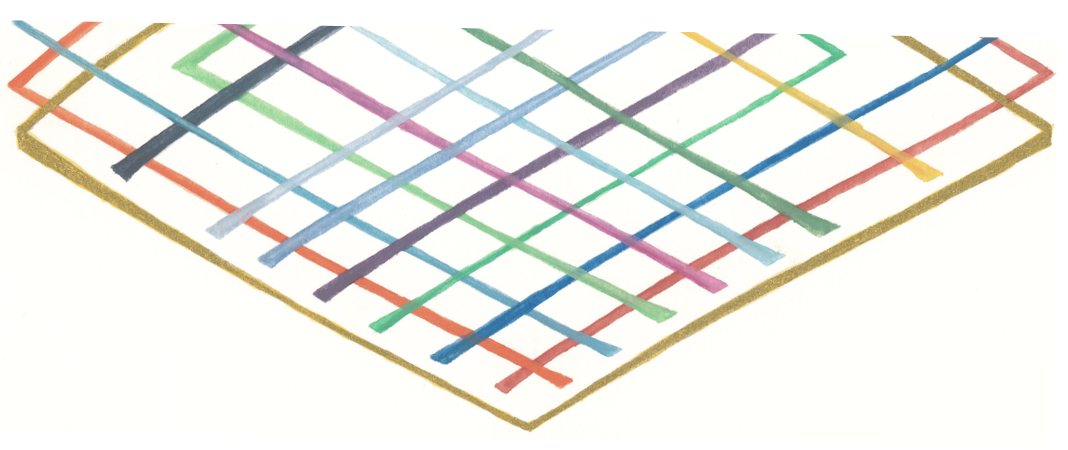
So this is us. The Gold is Jesus performing the last supper. The colorful strands are you, me, your neighbors, my neighbors, etc.
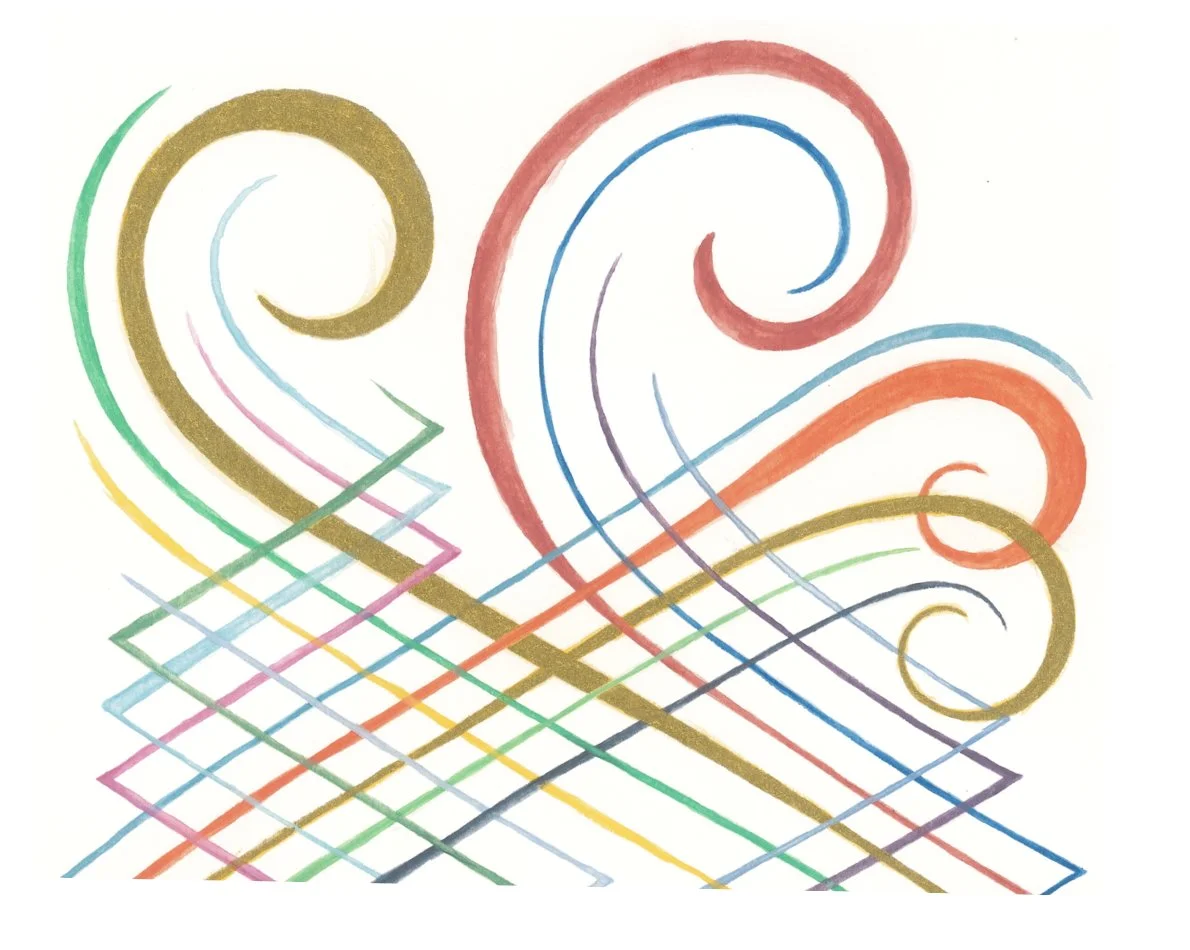
The A theme returns, and I see Christ returning to renew creation. You can see God the Father, God the Son, and God the Holy Spirit swirling at the top, and we are threaded into the celebration, which will never end, because it’s the beginning again.
So that’s it. That’s my visual and verbal interpretation of Alleluia Laudamus Te. It’s such a great piece. I can’t wait to meet Alfred Reed one day so I can tell him and thank him for writing it. Then I’ll go find Bach and thank him for writing Sleepers ‘wake. And then maybe I can ask King David to play Sleeper’s wake on his harp for me. Or Alleluia Laudamus Te. Or both!
If you think I’m sounding cheesy at this point, you might be right. But Doc won’t think it’s cheesy. He’s just as excited for eternity as I am. I know because there is no question of how much he loves Jesus. My absolute favorite thing about Doc is that He is constantly praising God. I mean CONSTANTLY. And there’s no way you could possibly doubt his sincerity. I wonder how much of that He got from conducting Alleluia Laudamus Te so many times over the years. Perhaps it’s been his Sleepers ‘wake all this time. It’s hard not to want to praise Jesus loudly and passionately after hearing this piece. And I imagine conducting it would be even more impactful. Either way, Doc has been a great influence on me in this regard. Thinking of his vibrant love for God gives me courage to display my love for God vibrantly. And I hope that I encourage at least one person to do so, as well.